 Metriq


Apple Health splits the calories you burn into two parts: Active Energy, from moving and exercising, and Resting Energy, what your body burns just to keep you alive. Your Move ring counts only Active Energy. That is why it is much smaller than the 2,000-odd calories a day you see on food labels, which are based on everything you burn.
Active Energy and Resting Energy
In Apple's own developer documentation, active energy is the energy burned due to physical activity and exercise, and does not include resting energy. Resting energy is what your body burns to maintain its normal resting state: breathing, circulating blood, and maintaining cells.
| Active Energy | Resting Energy | |
|---|---|---|
| What it is | Calories from moving: walking, chores, workouts | Calories your body burns at rest |
| Changes with | How much you move each day | Mostly your size, age and sex; fairly steady |
| Shown in | Move ring, Fitness app, Health | Health (Resting Energy) |
| Typical day | A few hundred calories, more on active days | Usually the larger part of the day's total |
Your total for the day is the two added together. In the Health app, open Browse → Activity to see both.
How Apple works them out
Both are estimates. Apple says the Watch uses your personal information, such as height, weight, sex and age, to calculate the calories you burn, so keeping those details up to date in the Health app makes the numbers better. Calibrating with outdoor walks also improves its distance, pace and calorie measurements.
Without a Watch, any Active Energy in Health comes from your iPhone or from other apps and devices, and the phone only knows about the time you are carrying it. Expect a lower and rougher figure than from a Watch worn all day.
Why the Move ring differs from food-label maths
Food labels and diet plans talk about the total calories you need in a day, which includes resting energy (and a little more for digesting food). The Move ring only shows the extra from moving. So a 500-calorie Move ring does not mean you burned 500 calories all day; your resting energy comes on top of that.
This also explains why walking calculators give different numbers. A table that counts total calories during a walk includes the resting calories you would have burned anyway; Active Energy leaves them out. Our calories burned walking guide shows both, and the formula to work them out, and the walking calorie calculator shows both for your own walk.
One more caution: do not add Active Energy to a food budget that already assumes an active lifestyle, or you count the same calories twice. If you are using calories for a medical reason, ask your doctor or a dietitian which figure to use.
How Metriq uses calories
When a competition or your daily goal uses calories, Metriq reads Active Energy from Apple Health, the same kind of calories as your Move ring. Resting Energy is not counted, so a calorie competition measures what people actually did that day, not their body size at rest. If you have another tracker that writes Active Energy to Apple Health as well, Metriq counts one source per metric so a walk is not counted twice, and you can choose which under Data Source in Metriq's settings.
Competing on calories fairly
Even Active Energy is not a level playing field. A bigger person burns more calories for the same walk: from the formula in our walking guide, 30 minutes at 3 mph is about 100 calories above resting at 150 lb and about 133 at 200 lb. Fitness, age and the device worn change the figure too.
- Similar group, calories are fine. Calories reward any kind of effort, from a run to a bike ride, which is why some groups like them.
- Mixed group, pick something else. For people of different sizes, compete on steps or distance, or on exercise minutes, which counts time spent moving at least as hard as a brisk walk and depends less on body size than calories do.
- Or remove the ranking. A Mission adds everyone's numbers into one shared goal, and a Streak lets each person aim for their own daily bar.
More ideas are in how to win a step competition and Apple Watch competitions with friends.
The calorie streak: one donut for every 250
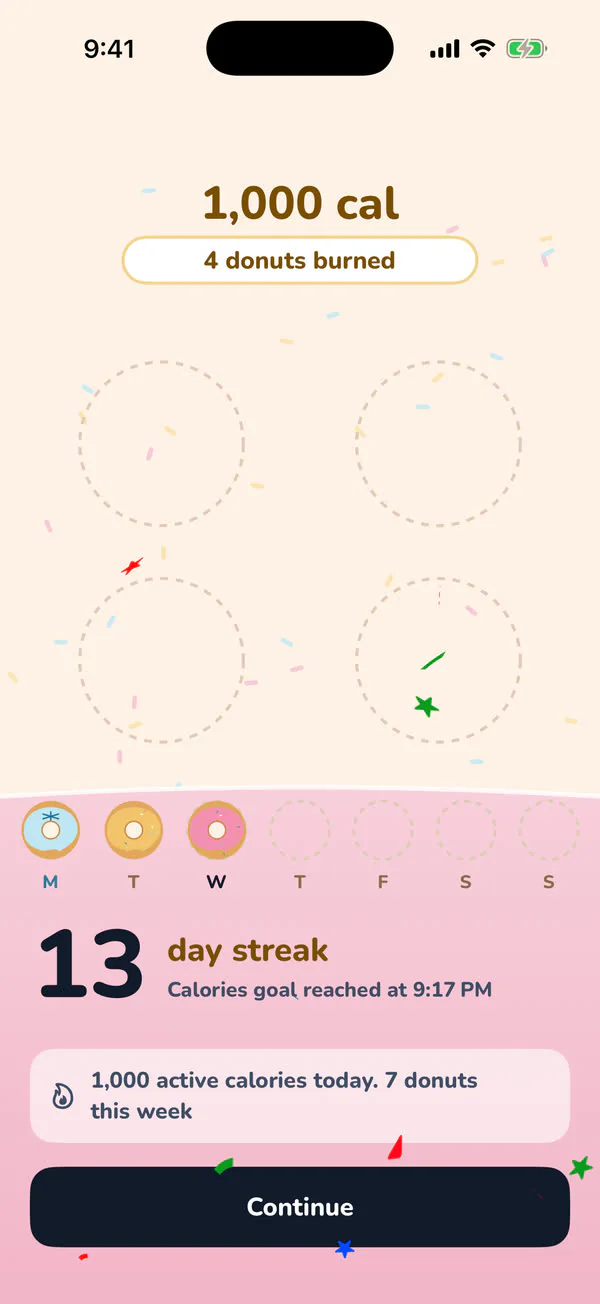
In Metriq you can set your daily goal in calories. Every day you reach it, your streak grows by one and a short scene plays: one donut for every 250 active calories you burned that day, so a 1,000-calorie day is four donuts. It is a light-hearted way to see the effort, not a suggestion to eat them.
Metriq is free on iPhone: join any competition, and create two at a time of up to 10 people and up to 7 days. Metriq Pro, at $32.99 a year or $6.99 a month, allows up to 100 people and any length. Competitions can use steps, distance, calories, exercise minutes or flights climbed.
Frequently asked questions
What is the difference between active and resting calories?
Active calories are the extra you burn by moving. Resting calories are what your body burns to keep running even when you are still. Your total for the day is the two added together.
Should I count active or total calories for weight loss?
Your daily calorie needs are based on the total. Active calories are useful for tracking what your movement added, but take care not to count them twice if your food plan already assumes you are active. A doctor or dietitian can help with a personal plan.
Why are my Apple Watch active calories different from my friend's for the same walk?
Calories depend on body size, age, sex, heart rate and fitness, so two people on the same walk burn different amounts. That is why steps or distance are fairer for mixed groups.
Does Metriq count active or resting calories?
Active calories only. Metriq reads Active Energy from Apple Health, the same kind of calories as the Move ring, for competitions and daily goals that use calories.
Related: Apple Watch vs iPhone step count, calories in 10,000 steps, and the step challenge app page.